
This article is part of ENCOM Pakistan’s practical planning series, adapted from Bosch’s Planning Guide for Steam Boiler Systems. If you are joining in from here, we recommend reading the previous piece first: ‘How to Plan a Steam Boiler System’. It sets the foundation for how to think about boiler projects before you touch pressure, steam output, or fuel.
Now, let’s talk pressure, because in industrial plants across Pakistan, this is one of the most common reasons steam systems stay efficient on paper but expensive in real life.
Why Over-specifying Quietly Increases Your Fuel Bill
When our team walks into a boiler house, they usually glance at one thing early on.
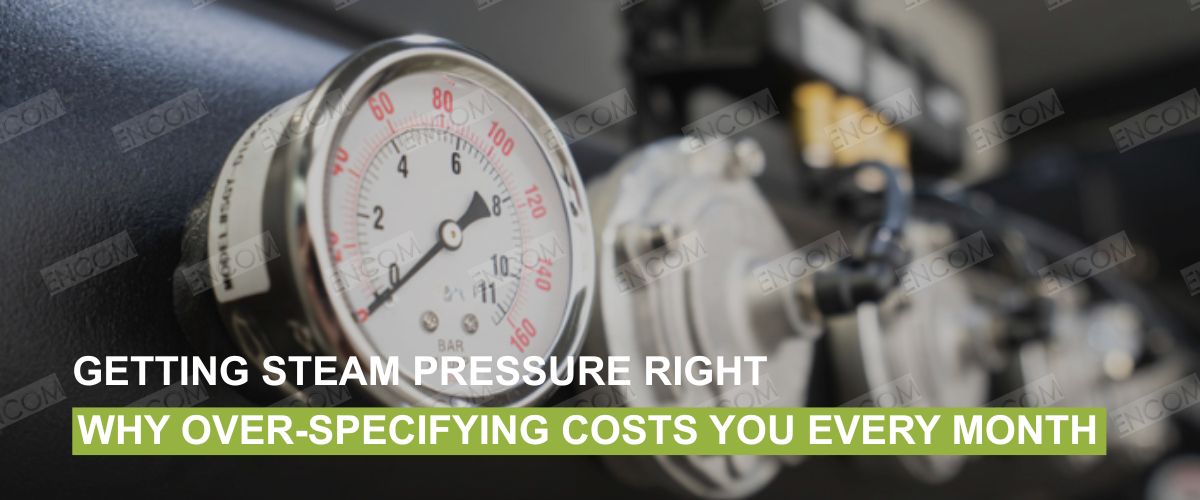
The pressure gauge.
Very often, it tells the same story. The boiler is designed for 16 bar. The plant operates at 13 or 14 bar. Yet the process, when examined closely, could run perfectly well at 9 or 10 bar.
Nobody sets out to waste fuel. Over-specification usually comes from good intentions. People add small safety margins at multiple points. Over time, those ‘just in case’ additions stack up and push operating pressure higher than necessary. Once that becomes the normal set-point, the plant pays for it every hour the boiler fires.
Two Pressures, Two Different Jobs
Bosch makes a clear distinction between two values that many teams accidentally blend.
Average operating pressure (p_avg) is the working pressure your boiler control system regulates around. During normal operation, the pressure fluctuates around this set-point.
Maximum permissible operating pressure (p_max,perm) is a fixed design limit set by the manufacturer. It is stamped on the data plate and protected by the safety valve. Bosch also grades key switching points as percentages of this value.
Here is the key idea that unlocks better planning:
You should define average operating pressure from the process backwards, not from the boiler nameplate forwards.
The maximum permissible pressure is where safety margins belong. It should not become your daily operating target simply because it is available.
How Bosch Recommends Choosing the Right Average Pressure
In the pressure chapter, Bosch lays out a practical method.
Start with what the consumer actually needs:
1. Identify the maximum pressure or temperature required at the consumer.
2. Use steam tables or the boiling curve to convert temperature needs into saturation pressure.
3. Add realistic pressure losses, such as:
- Losses in the steam line from boiler to consumer
- Losses across control valves and fittings
- Losses across any pressure reducing stations
4. From there, calculate the required p_avg at the boiler.
5. Only after that, select the minimum p_max,perm needed for the boiler pressure class.
Bosch includes a note that many planners skip, even though it explains why pressure gets over-specified:
At this stage, it is advised to work without safety margins so the operating conditions reflect reality.
If you want margin, add it later when defining the maximum permissible operating pressure. Do not bury it inside your average pressure.
That one habit alone can prevent years of inflated running cost.
How ‘Just a Little Extra’ Becomes a Permanent Monthly Expense
In real projects, over-specification rarely comes from one big mistake. It comes from three or four small ones.
- A margin at the process requirement.
- Another margin on pressure losses.
- Another margin on boiler selection.
Soon, a system that needed 9 to 10 bar ends up operating at 12 to 13 bar, and the plant pays for higher heat losses and higher stress levels without gaining value at the consumer.
Higher pressure also tends to push teams into smaller pipe sizing decisions because steam becomes denser at higher pressure. That can look cost-effective upfront, but it often creates constraints later when the plant expands or load patterns change.
Why Lower Is Not Always Better
Pressure optimization is not about chasing the lowest number.
If average operating pressure drops too far:
- Steam velocity increases because specific volume rises
- High velocity can cause erosion in valves and elbows
- Flow noise increases
- Droplet carryover risk can increase
Feedwater pumps can also become unstable if operating conditions move into a poor part of the pump curve. Cavitation becomes a real risk.
So the target is not ‘as low as possible.’ The target is the lowest practical operating band that protects steam quality, process stability, and mechanical reliability.
This is where calculation matters, and field experience matters too.
Tuning Your Current System for Immediate Savings
The good news is that many plants can unlock savings without buying a new boiler.
A pressure reset and control optimization initiative often includes:
1. A walkthrough of consumers, line lengths, and valves
2. A short measurement campaign for pressure and temperature at key points
3. Stepwise adjustment of:
- Boiler set-point
- Burner switch-on and switch-off limits
- Boiler sequencing if multiple units run together
Many plants also benefit from a practical two-level strategy:
- Higher pressure during heavy production windows
- Reduced pressure during light-load periods, without going below safe limits
This approach reduces radiation losses and often improves overall stability.
How ENCOM Approaches Pressure Reviews
At ENCOM, we treat pressure reviews as engineering work, not a sales conversation. With over 20 years in industrial heating and close exposure to OEM best practices, our teams apply the p_avg and p_max,perm logic in a way that matches real operating conditions in Pakistani plants.
In a typical review, we:
- Map critical consumers and required temperatures
- Convert requirements using steam tables
- Verify real pressure losses through measurement
- Compare control settings against Bosch’s recommended pressure grading
- Implement a monitored, stepwise pressure reset
Our objective stays simple: reduce waste while protecting reliability, compliance, and production continuity.
Closing Thought
If your pressure gauge has been showing the same number for years, that number may come from old assumptions, not current needs.
A small set-point change in a system that burns fuel around the clock can become one of the most cost-effective efficiency moves a plant makes.
If you would like ENCOM to help you validate your operating pressure and identify stacked safety margins, our engineering team can support you with a structured pressure review and full lifecycle technical support.