Walk into any plant and ask one simple question: ‘Why is your fuel bill creeping up every quarter?’
Most teams will point toward gas pressure, burner settings, or production load. Very few will look at the water. Yet, in our experience across industrial plants, untreated or poorly treated water remains one of the most expensive silent issues inside a boiler system.
Scale does not fail your boiler overnight. It builds quietly, layer by layer, until efficiency drops, risks increase, and maintenance becomes reactive instead of planned.
What Scale Really Does Inside a Boiler
At a basic level, scale is a layer of minerals, mainly calcium and magnesium, that deposits on heat transfer surfaces. It forms when hard water is heated.
Now here is the real problem. Scale behaves like an insulator.
Steel transfers heat efficiently. Scale does not. Even a thin layer forces the boiler to burn more fuel just to achieve the same output.
In practical terms:
- A 1 mm layer of scale can increase fuel consumption by 2 to 3 percent
- Thicker deposits can push losses into double digits
- Heat stress on tubes increases, leading to premature failures
This is not just an efficiency issue. It becomes a reliability risk.
We have seen cases where operators keep increasing firing rates to maintain steam demand, without realizing the heat is not reaching the water effectively anymore.
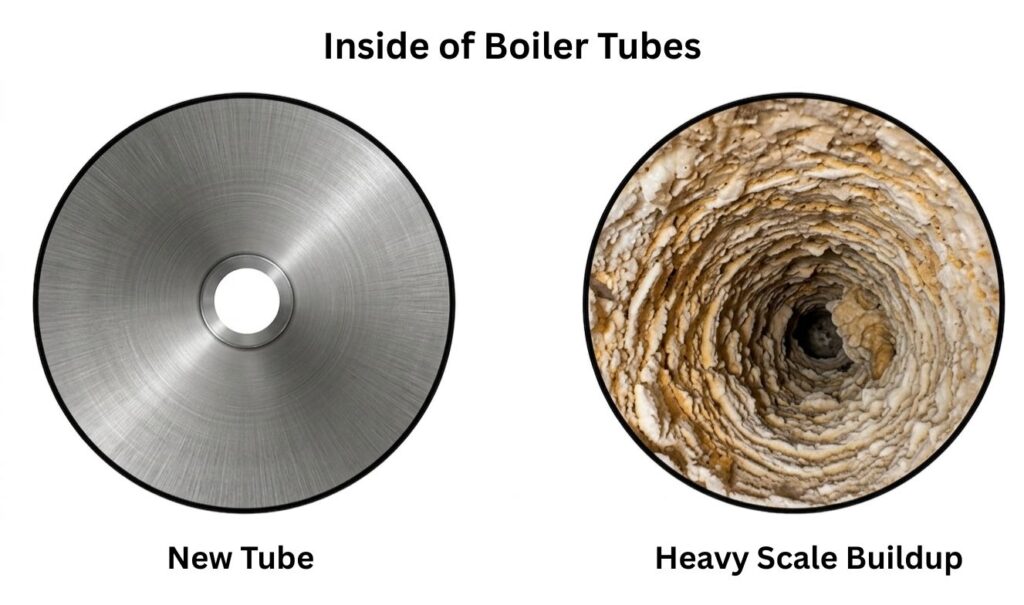
Even a thin layer of scale significantly reduces heat transfer, forcing higher fuel consumption for the same steam output.
Early Signs Most Plants Overlook
Scale rarely announces itself clearly. However, the system always gives signals if you know where to look.
Some common indicators include:
- Gradual rise in fuel consumption without change in load
- Higher stack temperatures than normal
- Frequent burner cycling or unstable operation
- Reduced steam output despite consistent firing
- Tube overheating or unexpected shutdowns
In many Pakistani plants, these signs are often attributed to fuel quality or equipment aging. Water quality rarely gets the attention it deserves.
A Familiar Scenario
Consider a mid-sized textile unit running a fire tube boiler. Production remains stable, but fuel costs rise by 10 to 12 percent over six months.
The maintenance team checks the burner. It gets tuned. No major improvement.
Later, during a shutdown, they open the boiler and find heavy scale on the tubes. Heat transfer had already dropped significantly.
The cost of cleaning, downtime, and excess fuel burned over those months often exceeds what proper water treatment would have cost for an entire year.
This is where most plants lose margin without realizing it.
Controlling Scale Starts with Discipline, Not Equipment
Many facilities install water softeners but treat them as a one-time solution. In reality, performance depends on consistent operation and monitoring.
A few fundamentals make a measurable difference:
Proper Water Softening
Softener systems must be sized correctly and regenerated on schedule. Resin exhaustion leads to hardness leakage, which directly feeds scale formation.
Continuous Chemical Dosing
Internal treatment is equally important. Oxygen scavengers, scale inhibitors, and pH control chemicals protect the system from inside. Dosing must match load conditions, not remain fixed.
Blowdown Management
Controlled blowdown helps remove dissolved solids before they concentrate and deposit. Excessive blowdown wastes energy, while insufficient blowdown accelerates scaling.
Regular Water Testing
Without testing, everything becomes guesswork. Daily checks for hardness, TDS, and alkalinity provide early warning signals.
Why This Becomes a Strategic Issue
When scale builds up, the impact is not limited to fuel loss. It affects production planning, maintenance schedules, and compliance.
Unplanned shutdowns disrupt operations. Tube failures increase safety risks. In regulated industries, inefficiencies can even affect environmental compliance.
From a management perspective, this is not a maintenance problem. It is an operational cost driver.
Where Experience Makes the Difference
Over the years, we have seen that plants do not struggle due to lack of equipment. They struggle due to gaps in system understanding and integration.
Water treatment, combustion, and heat recovery are interconnected. Treating them in isolation often leads to partial fixes.
This is where a lifecycle approach matters. From system design and commissioning to ongoing monitoring and optimization, each stage plays a role in preventing issues like scaling.
At Encom Pakistan, this is how we approach industrial systems. Not as standalone products, but as engineered solutions that must perform reliably under real operating conditions.
Final Thought
Scale is easy to ignore because it builds slowly. But the cost shows up every day in your fuel bill, your maintenance logs, and eventually your downtime.
The question is not whether scale is forming. The question is how early you detect it and how effectively you control it.
If your boiler efficiency is drifting or your operating costs are rising without a clear reason, it is worth taking a closer look at your water.
And if you need a more structured approach to diagnosing and optimizing your system, working with a partner that understands both the equipment and the operating reality can make all the difference.