
This article is part of ENCOM Pakistan’s practical planning series, adapted from Bosch’s Planning Guide for Steam Boiler Systems. We are now in the fifth article under the Planning section, focusing on installation and the decisions that shape long-term performance.
If you are joining in from here, we recommend reading the previous piece: ‘Fuel Choices in Pakistan’. It will help you better understand how planning decisions connect across the system and why no single choice works in isolation.
Now, let’s shift the discussion to something that often gets overlooked during planning but shows up later as recurring problems.
The Most Expensive Boiler Problems Start in Planning
What if the issues in your boiler house today were decided years ago, before the first startup?
And what if the real problem isn’t operation, but the assumptions made during planning?
It’s not a comfortable thought, but it’s one we’ve seen play out across industries in Pakistan.
When a boiler starts underperforming, the usual response is to question operators or maintenance. However, if you go back to Bosch’s failure prevention insights, the message is quite clear. Many of the most persistent and expensive problems don’t begin in operation. They begin on the drawing board.
At ENCOM, we’ve worked with plants that spent years trying to ‘fix’ systems that were never set up correctly in the first place. Let’s walk through where things typically go wrong and how these decisions quietly shape long-term performance.
When ‘Playing It Safe’ Backfires
Oversizing a boiler often feels like a safe decision. You plan for peak demand, add margins, and expect reliability.
In reality, this approach creates more problems than it solves. An oversized boiler cycles frequently, struggles at low loads, and consumes more fuel than necessary. Over time, this leads to unstable steam supply and rising operating costs.
In a market where fuel prices fluctuate, this is not just inefficiency. It becomes a permanent financial burden.
The Risk of Assuming Stable Gas Supply
Another common planning gap is assuming consistent gas pressure. On paper, supply conditions look stable. In practice, they rarely are.
Seasonal variations, pressure drops, and interruptions are part of the operating environment. When these are not accounted for, burners fail to reach full load, flames become unstable, and shutdowns start happening without warning.
We’ve seen systems that were technically sound but never delivered rated performance simply because real gas conditions were ignored during planning.
The Boiler Room Is More Than Just Space
Boiler house design often gets reduced to fitting equipment into available space. But performance depends heavily on how that space is planned.
Poor ventilation affects combustion. Tight layouts delay maintenance. Limited access makes routine servicing unnecessarily difficult.
Over time, these constraints increase downtime and reduce system reliability. What seems like a layout decision during planning turns into an operational challenge every single day.
This is what a properly planned boiler house actually looks like when you map all critical components together.
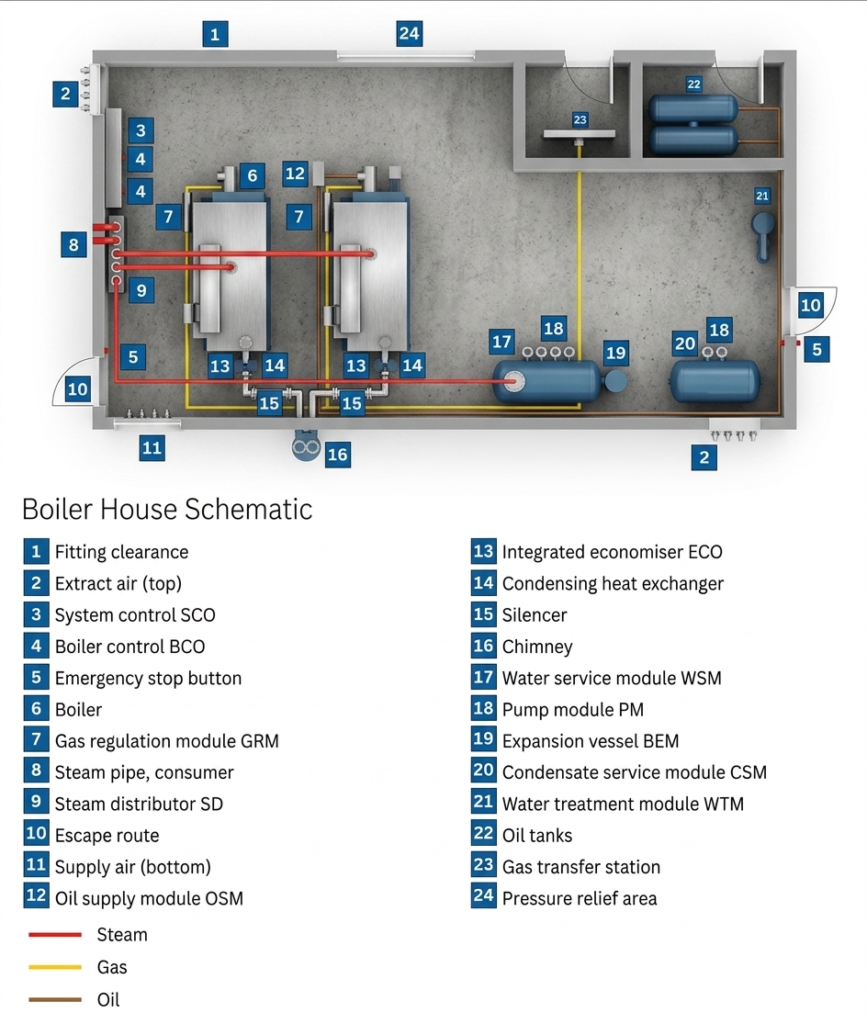
Every element here, from ventilation and gas regulation to condensate handling and safety clearances, plays a role in how reliably the system performs over time.
Steam Systems Don’t End at the Boiler
A boiler is only one part of the system. The real performance comes from how steam and condensate move across the plant.
When piping is not sized correctly, or slopes are ignored, problems begin to surface. Condensate starts accumulating. Water hammer becomes frequent. Heat losses increase.
These issues don’t just reduce efficiency. They damage equipment and shorten system life. Yet, they almost always trace back to early design decisions.
Water Quality Is Not an Afterthought
Water treatment often gets attention later than it should. But in reality, it is central to boiler performance.
When treatment systems are undersized or poorly planned, scaling begins inside the tubes. Heat transfer drops, fuel consumption rises, and the boiler starts losing efficiency much earlier than expected.
This is one of the fastest ways to turn a high-efficiency system into an expensive liability.
What We See on Ground
In one case, a plant struggled with frequent burner trips, inconsistent steam pressure, and constant maintenance issues. Multiple teams had already attempted fixes.
When we assessed the system, the root causes were clear. Gas pressure assumptions were off. Ventilation was insufficient. The piping layout allowed condensate buildup.
Once these planning gaps were addressed, the same equipment started performing reliably. No major replacement was needed. Just better alignment with how the system should have been planned from the start.
Signs You Should Not Ignore
If a boiler frequently cycles, struggles during peak demand, or consumes more fuel than expected, it’s worth taking a closer look. The same applies if maintenance takes longer due to access issues or if you notice condensate problems in the system.
These are not random faults. They are often signals of deeper planning gaps.
Why It Matters More Today
Operating conditions are becoming more challenging. Fuel costs are rising. Gas availability is uncertain. Efficiency is no longer optional.
In this environment, hidden inefficiencies built into your system can quietly erode profitability.
The good part is that many of these issues can be identified and corrected without replacing the entire boiler.
A Smarter Way Forward
A well-running boiler is not just about good equipment. It is about making the right decisions early and revisiting them when performance doesn’t match expectations.
At ENCOM, we approach this from a system perspective. We evaluate real operating conditions, align designs with Bosch best practices, and help plants uncover what’s often hidden beneath day-to-day issues.
If your system shows even a few of these signs, it may be time to look beyond operations and revisit the foundation.
Because in most cases, the real story of your boiler started long before it was switched on.